
You’ve finished the training block, dialed in the nutrition, and your practice numbers are the best they’ve ever been. Then the whistle blows, and the body that never misses in warm-ups rushes the first shot, grips the club through the takeaway, forgets the game plan by the second quarter. Nothing degenerated physically between Thursday and Saturday. What changed is the state the body is being run in — and that state is set long before the opening whistle by a layer of mind most athletes never train directly. This is the gap hypnosis for athletes closes: a pre-performance reset that trains composure the way you train strength — as a conditioned, repeatable physiological skill, not a pep talk you hope shows up on game day.
The standard advice — trust your training, stay loose, control your breathing — isn’t wrong, just slow. Every one of those instructions is administered by the conscious mind, the same busy supervisor that panics under pressure in the first place. The nerves aren’t running there. Pressure is appraised as threat by the automatic layer underneath, and that layer tightens muscle, narrows vision, and rushes tempo without asking permission. A reset that works has to reach that layer directly. That is exactly what a trance session does: absorbed attention, a rehearsed calm, and a cue that hands the body back to what it already knows. Below: what it changes, the research, and a 21-day protocol for installing your own reset.
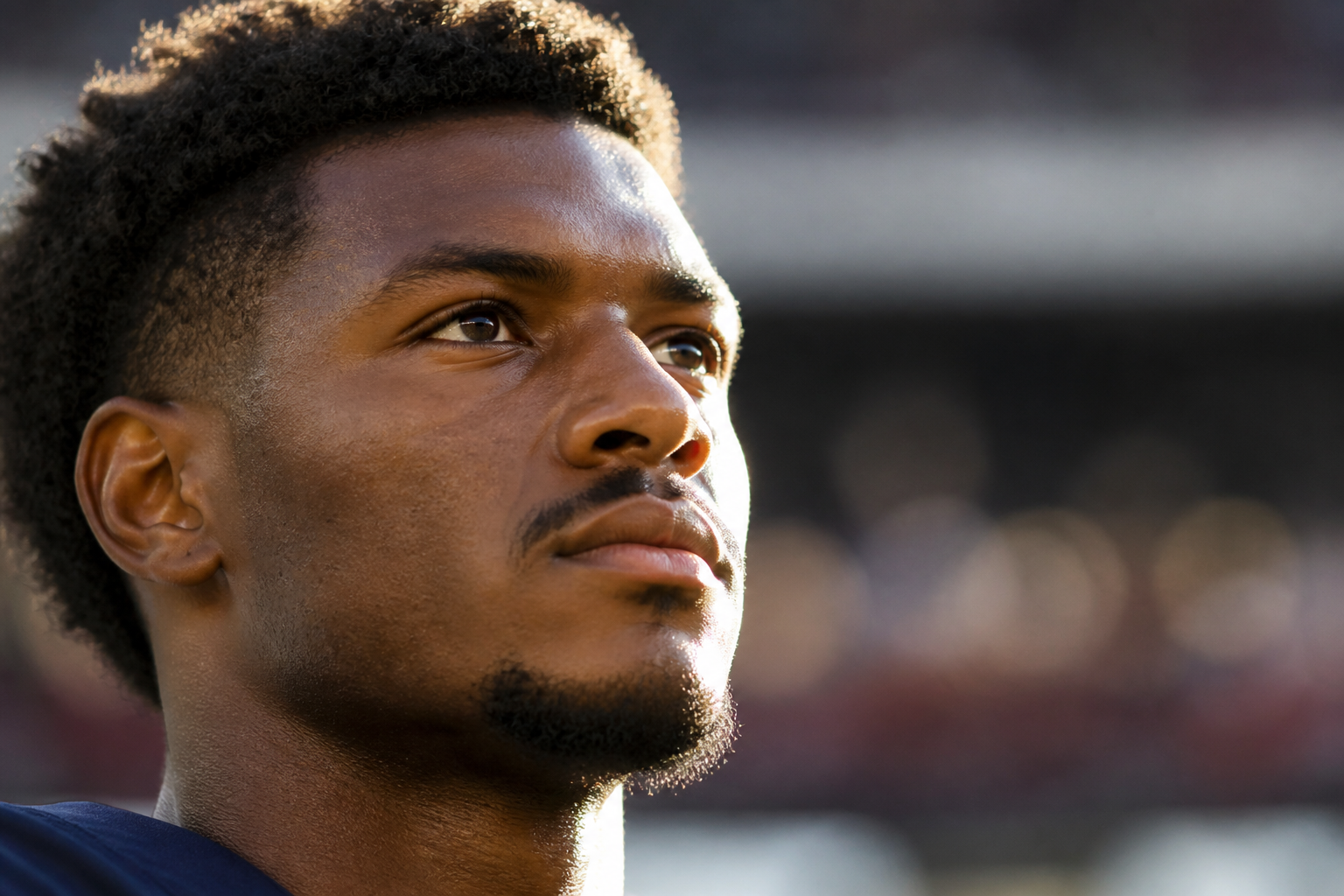
What Hypnosis for Athletes Actually Changes
Strip the mysticism first. Hypnosis is a state of absorbed, single-pointed attention in which the critical, monitoring part of the mind stands down and suggestion reaches the automatic layer directly — the layer where motor programs, emotional appraisals, and physical habits are stored. Sport performance lives in that layer, which is why it makes sense to train it there. Three things change.
It installs composure as a conditioned cue, not a wish. Composure can’t be summoned mid-competition by wanting it; it has to be pre-built. In trance, you pair the deepest point of the relaxed, absorbed state with a simple physical cue — two slow breaths and a soft gaze at one fixed point. Repeated daily, the pairing behaves like any conditioning protocol: after a few weeks, firing the cue pulls a measurable fraction of the calm back on demand. The athlete who fires it in warm-up isn’t hoping to feel loose. They’re pulling a state they spent 21 days installing.
It hands the body back to the programs that actually run it. Skilled movement is automatic — the swing, the shot, the stroke execute best when nobody supervises them. Under pressure, attention escalates upstairs: the conscious mind starts monitoring mechanics in real time, and the disruption that follows is what sport psychologists call paralysis by analysis. Trance is daily practice in the opposite move — stepping supervision down and letting the trained program execute. That absorbed, no-monitor state isn’t a metaphor for flow; it is the psychological signature flow researchers describe.
It rewrites what pressure means. Fight-or-flight is triggered by appraisal, not by circumstances: the same pounding heart can be coded as dread or as readiness. Suggestion in trance renegotiates the appraisal directly — arousal becomes fuel, the crowd becomes background, the moment becomes just another rep. The body doesn’t need to change first. What its signals mean needs re-labeling, and the label lives below conscious access.
The Science: Flow States and Suggested Calm
The sport-specific evidence is small but unusually concrete. In a controlled intervention study, three competitive basketball players received a hypnosis program pairing relaxation with performance cues across weeks of three-point shooting sessions: both shooting accuracy and measured flow-state scores improved over the intervention period (Pates, Maynard & Westbury, Journal of Applied Sport Psychology, 2001). The design is case-study scale, but it tested the claim that matters here: a hypnotic procedure can move both the state and the scoreboard, not just self-reported calm.
The broader foundation is better powered. A meta-analysis of 35 studies on mental practice — rehearsing a skill in imagery rather than in motion — found reliable performance improvements, strongest for tasks with large cognitive components (Driskell, Copper & Moran, Journal of Applied Psychology, 1994). Imagery run inside an absorbed, trance-like state is precisely the condition that research treats as optimal for mental rehearsal.
Add the physiology and the mechanism is coherent. Trance reliably shifts the body toward parasympathetic dominance — slower breath, lower heart rate, released muscle tone — which is the biological substrate of composure, not just a description of it. And in absorbed, inward-focused states, the default mode network — the brain’s self-referential narration hub, where what if I miss loops run — quiets down. The reset is physiological, rehearsed, and cue-triggered. Nothing mystical is required to explain it.
Why Performance Anxiety Is a Subconscious Problem
Here is why the standard advice stalls. The conscious mind is serial and expensive: it holds a handful of items, runs one comparison at a time, and cannot execute a golf swing or a free throw in real time — those were handed to the automatic layer years ago. Under pressure, the mind escalates to the supervisor anyway. That escalation feels like diligence (watch your elbow, don’t rush it) and performs like sabotage, because supervision disrupts programmed movement. The problem isn’t that athletes can’t concentrate. It’s that they’re concentrating at the wrong layer, on the wrong object.
The trigger for the escalation is the appraisal stored underneath: at some point, competition got coded as threat — evaluation, consequences, a history of failure — and the coding was never consciously chosen. Nobody decides to fear a free throw; the loop was absorbed from an environment that punished missing. More practice reps don’t touch it — the body already owns the skill. Pep talks don’t reach it — they’re delivered to the conscious layer the loop bypasses. Pre-shot routines help because they occupy attention, but they don’t renegotiate the appraisal; they outsource it for ten seconds.
Hypnosis reaches the layer where the appraisal and the state are stored. In the relaxed, absorbed condition, suggestion can re-code pressure as information rather than threat, and install the downshift itself as an automatic cue instead of a conscious decision. The athlete stops needing to remember to stay calm; the calm is fired by a breath and a fixed point, the way a serve is fired by a toss.
The 21-Day Pre-Performance Reset Protocol
This is a conditioning job, not an insight job. Run the same five steps daily for 21 days; sameness is the active ingredient.
Step 1: One trance session, same time every day. Fifteen to twenty minutes, ideally morning or right after training. A structured session like Gaze — The Fixed Point is built for exactly this: guided fixed-point attention with a consistent voice and tempo. Same room, same chair, headphones on, phone in another room — the consistency isn’t preference; it’s the conditioning signal.
Step 2: Define your reset in three words and one cue. Once, on day one: choose the state words that describe your best performance (loose, tall, quiet eyes) and one physical cue — two slow breaths and a soft gaze at one fixed point: the rim, the seam, the horizon. Write it down. The reset must be small enough to run at the free-throw line.
Step 3: Install the anchor inside the trance. In the final minutes of each session, pair the deepest point of the state with the cue: fire the two breaths and the fixed-point gaze while the relaxation is strongest. The pairing is the whole mechanism — state first, cue second, every day.
Step 4: Rehearse from inside the body. Spend three to five minutes of each session running first-person imagery of your sport — not watching yourself, but executing: tempo, breath, contact, follow-through. Include the recovery script explicitly: a mistake, the anchor firing, the reset, the next rep. Athletes rehearse the error response as deliberately as the perfect shot, because the error response is what pressure tests.
Step 5: Deploy in stages, repeat 21 days, judge in weeks. Week one is mechanics — sessions and pairing do the work. Week two: fire the anchor in warm-ups and low-stakes reps until it produces a noticeable shift. Week three: deploy in competition. If you miss a day, resume — don’t double up. Most people report the shift as subtraction: the same moment, minus the noise.
Frequently Asked Questions
Will I lose control or get stuck in trance?
No. Trance is absorbed attention, not surrender — you hear everything, remember the session, and can open your eyes at any point. Sport hypnosis is done while you are fully in charge, which is the point: the state belongs to you, fired by your cue.
Isn’t this just visualization with better branding?
Visualization is one step of the protocol, and the trance state is what makes the other steps work. Imagery run from a scattered, anxious state rehearses the scattered state — which is why the research effect concentrates under absorbed conditions. The anchor, the pairing, and the appraisal work have no visualization equivalent.
What if it doesn’t work for me?
Check responsiveness honestly: a minority of people are low-hypnotizable, and for them trance feels like reading a menu. If nothing shifts by day 10, swap mechanisms instead of forcing this one. The highest-value adjacent lever is sleep: sleep debt taxes reaction time, accuracy, and decision quality more reliably than any mental skill, and a nightly session like Coil — The Sleep Descent repairs the state the reset runs in.
Can this replace medical or psychological care?
No. Hypnosis is a performance and composure tool. For injuries, pain management, eating disorders, or clinical anxiety, it complements — never replaces — care from qualified medical and mental-health professionals.
The Focus–Sleep–Weight Triangle
Performance doesn’t stay in one corner of life. Sleep debt taxes reaction time and accuracy first — the sleep corner is Coil — The Sleep Descent, a nightly descent protocol for athletes who train hard and sleep late. Scattered attention is the same machinery this article trains — the focus corner, Gaze — The Fixed Point, the daily attention session behind the reset. And the off-season loop of stress-eating and body-composition drift is its own subconscious pattern — the weight corner, Hunger — The Shedding. Fix the corner you’re standing on; the other two get measurably easier.
Train the State That Trains You
The training block built the body. The reset trains the state that operates it. One session, one cue, twenty-one days of repetition — and game day stops being a test of whether the nerves showed up. Start tonight with Gaze — The Fixed Point — and let your subconscious do the heavy lifting.